
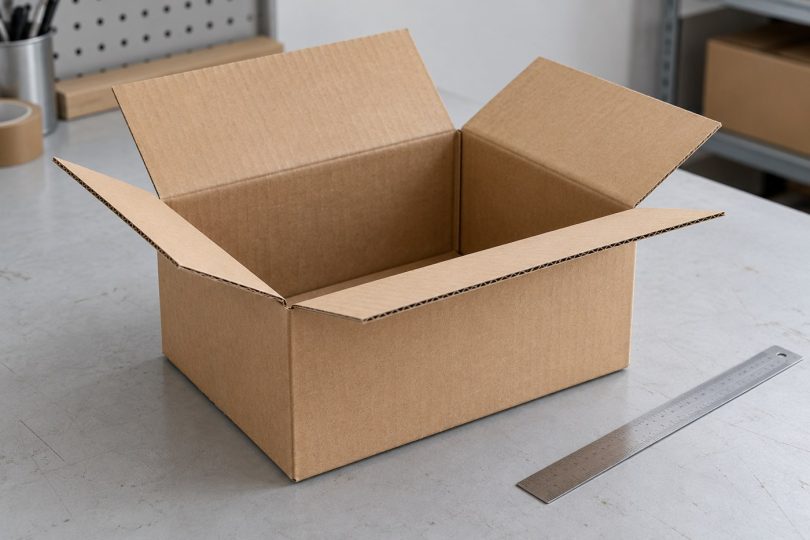
To order a custom cardboard box, you need to provide the length, width and height, and specify whether these are internal or external dimensions. Internal dimensions determine the space available for the product; external dimensions help you calculate how much space the closed packaging will occupy.
Confusing them can leave you with a box that does not fit the product or a package that takes up more space than expected. This guide helps you prepare the dimensions before consulting our cardboard box catalogue.
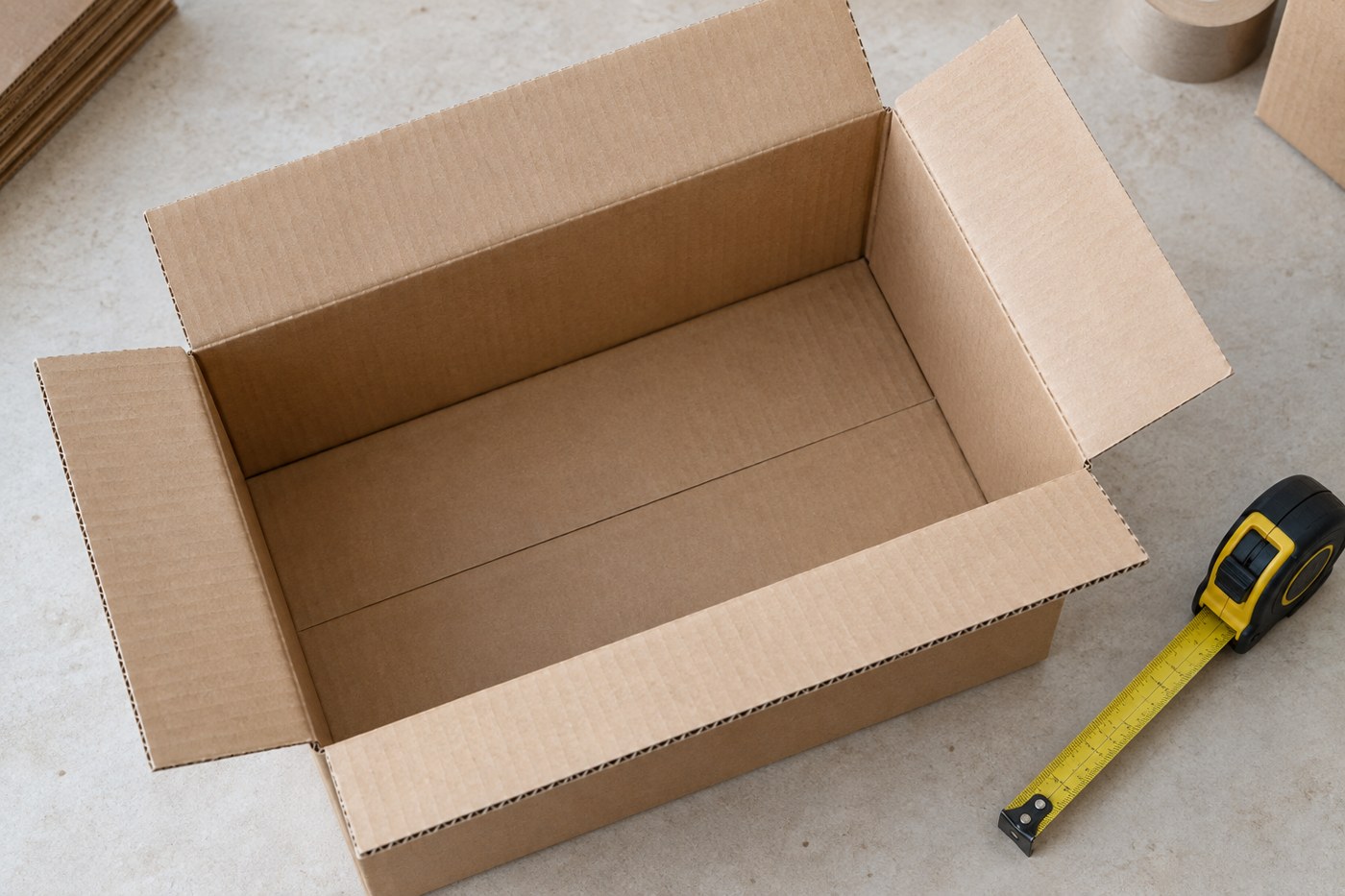
What are the internal dimensions of a box?
These are the usable dimensions inside the assembled box. They must accommodate the product and everything accompanying it: dividers, bases, protective inserts, bags or documents. Measuring the product alone is therefore not always enough to specify the packaging.
If you are placing several units in the same box, plan the complete arrangement first. Two products packed together may need extra space for a divider to prevent contact between them.
What are external dimensions used for?
External dimensions describe the space the box occupies on the outside. They matter when organising shelves, planning a pallet layout or checking a carrier's size limits.
Avoid calculating them by adding a fixed amount to the internal dimensions. The cardboard thickness, folds and box design all affect the result. When both sets of dimensions matter for your project, ask the manufacturer to confirm them.
How to measure a cardboard box step by step
- Prepare the product as it will be delivered. Include accessories and protective materials.
- Decide the shipping orientation. Packing an item flat is different from keeping it upright.
- Measure the length, width and height. For a rectangular base, clearly identify its two sides and measure the height to the highest point.
- Specify the space needed for inserts. Do not add an arbitrary allowance: explain what needs to fit and how it will be held in place.
- Note the units. Write all dimensions in millimetres or centimetres, without mixing the two.
Example: the product and its packaging have different dimensions
Imagine a product measuring 30 × 20 × 10 cm that will travel on a protective base. Those dimensions describe the item, but you still need to measure the base and decide whether protection is needed at the sides or on top. Check the complete assembly before ordering the box.
A clear way to word your enquiry is: “Product measuring 300 × 200 × 100 mm, positioned horizontally, with the base and inserts still to be specified. I need to confirm the box's internal dimensions.”
The box design also makes a difference
American-style or flap boxes close at the top and bottom using flaps. With self-assembly boxes, the folds and closure design also need to be considered when checking the usable space.
If the product has an irregular shape, do not describe it using just three dimensions without further information. A photograph or drawing showing protruding parts helps the manufacturer assess the design.
What details to send when requesting a quote
- Product dimensions and orientation inside the box.
- Total weight and number of units per package.
- Any dividers or other protective materials required.
- Number of boxes, printing requirements and expected date of use.
- External size restrictions for storage or transport.
Frequently asked questions about box dimensions
Should I state the length or width first?
Give dimensions in the order length × width × height, using the same unit for all three, preferably millimetres. Identify the sides of the base and measure the height with the box in its intended position. If the design could cause confusion, add a drawing with each dimension marked so the manufacturer can interpret your order correctly.
Can I measure an unassembled box?
You can measure the unfolded sheet to document existing packaging, but those dimensions do not represent its usable internal space. To order a box of the same size, assemble a sample and measure its inside and outside separately. The folds, cardboard thickness and closure must all be considered when reproducing it.
What is the difference between a box's internal and external dimensions?
Internal dimensions show the space available for the product and its protective materials. External dimensions describe the space occupied by the assembled, closed box, which matters for storage and transport. You cannot calculate one from the other by always adding a fixed amount: the difference depends on the cardboard and design.
How much space should I leave between the product and the box?
There is no universal allowance. Consider the protective materials, dividers and space needed to insert and remove the product without damaging it. Too much space can allow movement; too tight a fit can compress the contents. Specify the dimensions for the complete assembly and check a sample before confirming production.
What dimensions should I send when ordering a custom box?
Send the product's length, width, height and weight, and the position in which it will travel. Also specify how many units will go in each box and which accessories or protective materials must fit. Make clear whether you need specific internal dimensions or whether storage or transport imposes an external size limit.
Need a box tailored to your product? Browse our cardboard box designs and send us the dimensions, weight and quantity so we can assess your project.


