
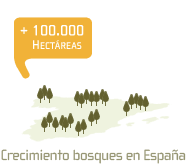
The concept of “forest management” refers to the management of forests cultivated by paper industry to maintain their biodiversity, productivity, capacity for regeneration and vitality while serving the economic, social and ecological needs of society. Not only those present, but also those of future generations, at local, national and global levels.
The 430,000 hectares of forest plantations destined in Spain to produce wood for paper production set about 50 million tonnes of CO2 equivalent per year. The annual increase in stored CO2 is 2.6 million tonnes.
The pine and eucalyptus plantations are continuously regenerating and replanting. As species of rapid growth, they have a very high productivity: they occupy only 6.7% of the wooded forest area and provide 57% of the annual use of wood for all uses.
In 2008, these plantations employed 14,558 workers (3,640 direct, 2.8 fewer than in 2007, and 10,918 indirect, 0.7 more than in 2007).
Stored CO2 amounted to 49.8 million tonnes of carbon equivalent in 2006 (last available figures), an increase of 5.5 per cent over 2005.
The commitment of the Carton manufacturers with the forest certification it is clear: in 2008 they had already certified their chain of custody 100% of the cellulose plants, 87% of the suppliers of cellulose and 54% of the suppliers of wood.
New laws such as the one requiring the use of paper bags from supermarkets, help maintain the commitment of the manufacturers of cardboard with the environment.


