Interview Daniel Calabuig. Founder of Six Degrees
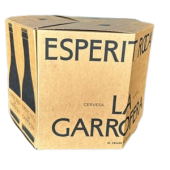
His last big campaign has given what to talk about: he contributed decisively to the sale of 15,000 cardboard boxes this Christmas — empty! «We created some boxes They contain a kilo of Love You, 775 hugs, a million cuddles... All we collected was to San Juan de Dios Hospital». Founder and creative director of the advertising agency Seisgrados, Daniel Calabuig (Valencia, 1973) is a strong defender of good stories.
What limits are placed on campaigning?
We don't work for political parties. But what is very important is that the product or brand you're working for is honest. It's hard for us to work with a soda that doesn't have bubbles and say it does. There is no better way to sink a bad product than to make good advertising.
To what extent does it have to be conventional in a campaign not to stun the consumer? Where's the limit?
Advertising, ultimately, is about conveying a story to an audience. The first step is to get someone's attention. That can be achieved through substance or presentation. A good example is The Artist: it is surprising that someone today would release a silent film, as in the 1920s, and manage to capture your attention and keep you engaged for an hour and a half. The form is old-fashioned, but it works. So both approaches work. In the long run, however, I think content is what endures. Because a new form will always come along and make people forget the last one.
How do you get up or flip a mark?
Neurologists say that our brains contain what are known as mirror neurons. They are responsible for our tendency to do what we see: if one primate yawns, the other does too. If we put a pretty girl beside a product, you inevitably associate the two. That is the basis: the brand itself has a story to tell, and advertising conveys it in one or more ways. For example: use this deodorant and you will be irresistible. Products without a story are more difficult. Stories are the best way we humans have to connect with one another. We need them, and they can come from friends and family, but also from advertisements.
Is everything already invented in advertising?
I think it's getting more and more complicated to get a message out. That's why our philosophy is to make them attractive. It's one thing to push a message from a series or a newspaper and another to create an app for mobile, or an event, or a video that catches your attention. I think the possibilities are almost endless.

In this sense, is the variety of channels complicating or making life easier for advertisers?
If you want to tell a story through advertising, you have to think about how to deliver it, because you no longer have everyone sitting in front of a device paying attention to you. You might need to plan to tell part of it on Facebook, another part in the street, another on television, and so on. The term most commonly used now is transmedia storytelling, a phenomenon already being applied in Hollywood: films with a book, video game, comic, etc. The challenge is to see how media can be used creatively to tell that story. Perhaps each medium can offer something specific. Campaigns need to be defined according to people's level of engagement.
Source: http://www.cincodias.com
From Fx Sanmartí we want to congratulate Daniel Calabuig for the initiative. Gifting recyclable hugs and kisses is a great idea!!!