
Another of our cardboard box stories by Josep Maria Serra
Valeria gets up feeling very happy. She rubs her big eyes, which seem permanently surprised because she opens them so wide. It is Sunday, and she has persuaded her parents to take her to neighbouring Cardboard City. At the camp her school organised during the last holidays, she met a girl who lives there, and they became close friends. Her name is Margarita, and she has been urging Valeria to visit her home one day. And that day has finally arrived.
Valeria feels uneasy. At her school, all the children speak badly of Cardboard City. How can they live without plastics? they exclaim. “How poor they are in Cardboard City!” Whenever she goes shopping at the supermarket with her parents and sees all the shelves full of products beautifully packaged in colorful plastic boxes, she wonders what a supermarket in Cardboard City would be like. She imagines it dark and colorless, with greasy cardboard boxes and products scattered on the floor.
And she feels the same way at school. Her pencils fit so neatly in their plastic pencil cases, and her plastic-coated backpacks are so cool. Valeria looks around and smiles as she takes in the colourful plastic furniture in her room. When her mother calls, she goes down to the kitchen for breakfast. She pours chocolate into the milk her mother serves in a green plastic cup, and eats her sandwich from a plate of the same colour and material as the cup. She takes a wonderful, shiny apple out of its transparent packaging and eats it, licking her lips. “I don't know why they say apples have a smell when they don't,” she thinks, holding it to her nose. She loves everything around her. She loves living surrounded by plastic.

Her father urges them to hurry, because if they want to arrive at 12, they need to leave now. Cardboard City is about a two-hour drive away. Unlike her, her father is in a bad mood. He does not like going to Cardboard City because he cannot drive into the city in his fantastic 120-horsepower petrol car. He has to leave it in a car park at the entrance and take electric public transport from there. For this reason, he has only been to Cardboard City two or three times in his life, always for work.
As they leave Plastic City behind, Margarita looks around. Mountains of plastic line the road to the right and left for kilometers. They cannot even see the trees. Margarita is so used to seeing this landscape that she pays it no attention. Once they have traveled far enough, the mountains of plastic begin to shrink, and little by little they find themselves surrounded by forests. Forests that stay with them all the way to Cardboard City.
Valeria hoped to find mountains of cardboard from miles before arriving, but she did not. At the entrance, large signs warn that the city cannot be accessed by combustion vehicle. Only electric or human-wheel drive vehicles can enter or animal. When she gets out of the car, Valeria is amazed by the silence. In your city you always hear a rumor of cars circulating day and night, but here you hear birds and cicadas.
Valeria! He hears someone screaming and running in his direction. It's Margarita. His blond hair swings with the air it causes when running. He's gone looking for them with his mother in a fantastic electric car. They embrace with great joyWhile her parents greet the girl and Margaret's mother who comes smiling.
On the way home, the girls keep talking and telling each other things. Valeria glances sideways at the street, expecting to see the dirty, poor city she had imagined Cardboard City would be, but she sees nothing of the sort. After a while, Margarita's mother tells them she is going to stop because she needs to buy a few things at the shop. It turns out that the city is full of shops selling food and other products. They are everywhere. "Don't you go to the supermarket?" Valeria asks Margarita. "The what?" she replies, looking puzzled. It turns out that there are no big supermarkets in Cardboard City, or shopping centers you have to drive to. Shops are everywhere, and you can walk to buy whatever you need.
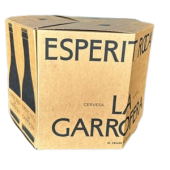
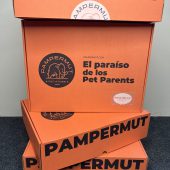
They all enter the shop and, while Margarita's mother looks for what she needs, Valeria walks around and is surprised to see everything neatly organised. Beautiful cardboard boxes hold the fruit, which shoppers choose and place in paper bags. She also sees products such as meat, rice, sauces, dairy products, chocolate and cereals, protected by wrappers made from a material she does not recognise, which Margarita tells her is recyclable. When they leave the shop, Margarita's mother gives Valeria an apple. She looks at it disapprovingly because it is not shiny. She bites into it and her eyes widen. “It's delicious!” she exclaims. Margarita laughs.
There are no detached houses in Cardboard City like there are in Plastic City. Here there are buildings, and people live in flats. But Valeria is amazed because all the buildings around her are built from modules, and every module is a different colour. They are like boxes placed on top of one another in a disorderly order. From the street, it is a real spectacle of shapes and colours. “We live in the apple-green one,” Margarita says, pointing to a four-storey building. At the top right is a beautiful green module with windows and balconies. Valeria no longer knows what expression to make; one surprise follows another. She expected to find an ugly, dirty city, and instead she is in a fantastic, surprising place where there is no noise and the street smells lovely.

“We can go to the pool,” Margarita proposes. “To the pool?” answers Valeria who doesn’t understand how there can be a swimming pool in an apartment. “Yes, yes, inside all apples We have a swimming pool and a garden“ It’s all right. ” The girls put on their swimsuits and go down. It's hot and it's very hot to soak. The pool is full of children. After a while they hear Margarita's mother calling them from the terrace.
The table is waiting for you. Margarita's father is a good cook and has prepared an assortment of grilled vegetables and a stewed chicken. It's all very good. Valeria's parents have brought a dessert cake. Girls eat fast. “Can we go for a walk and show Valeria the neighborhood?” says Margarita. “No problem for me, but come back before 6:00, which is the time we have to leave,” Valeria’s father tells them.
Valeria is fascinated by the public transport shelters. They seem to be built from tubes. Margarita, who keeps watching her, says, “Do you like them? They're made from painted cardboard tubes. Aren't they beautiful?” As they walk, Margarita keeps talking to her. “Look, that's the shop where we buy things for school, and that's where my parents find things for repairs around the house, and that other one is full of cooking utensils…” “What a lovely smell!” exclaims Valeria. “That's because the bakery is over there, and since they bake the bread in a wood-fired oven, depending on which way the wind blows, the smell of freshly baked bread fills the whole street,” Margarita explains. “But today's Sunday. Why is it open?” she asks. “Because in Cardboard City the bakeries take turns, so there's always one open in every neighbourhood on Sundays and we can always eat freshly baked bread.” Little by little, Valeria is losing her ability to be surprised.
They arrive at what looks like a sports center, and Margarita invites her inside. It is full of boys and girls playing sports. The large hall is divided into several courts, with a different sport played on each one. Football, basketball, badminton, volleyball. “Do you want to play something?” Margarita asks her. “I love this place. Is it always this busy?” Valeria replies. “It’s usually even busier,” Margarita answers with a laugh. “We’re very sporty in Cardboard City.”
A friendly blond boy runs up to them. “Hi Margarita, fancy a game?” he asks. “No, I'm with a friend.” “Well, she can join in too.” Valeria looks at them both and says she is sorry, but she does not know how to play volleyball. “Don't worry,” Margarita tells her, “and anyway, it's getting late and we should head home.” On the way back, they talk about school and what they do. And they realize that they live two hours apart but seem to live in two different worlds. Although they are the same age, they do not study the same things. That much is clear. Valeria studies algebra, spelling, history… while Margarita also studies things like ecology, survival, biology, cooking…
They arrive home shortly before six and go to Margarita's room. Margarita shows him the drawings she makes. They play with the console for a while.
“Valeria, get ready to go.“ They hear Valeria’s father shouting. They've been flying all afternoon. Both look at each other and hug each other. They had a great time and they don't want to split up.
On the journey back to Plastic City, Valeria is very quiet. He hears his parents criticize everything they've seen in Carton City. She's getting more angry. When they’re about to get home, he can’t go home anymore and bursts out and screams: “I want us to live in Carton City!”.