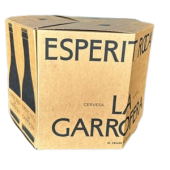

The carbon footprint (carbon footprint) is known as “all greenhouse gases (GHGs) emitted by direct or indirect effect of an individual, organization, event or product”.
The FEFCO (European Federation of Corrugated Cardboard Factorys) made public a statement in which it reports that the European manufacturers of corrugated cardboard has managed to reduce again, and substantially the carbon footprint (carbon footprint), in particular 11% over the last three years.
The carbon footprint refers to the impact of carbon on the full life cycle of corrugated cardboard containertaking into account emissions of greenhouse gases, fossils and biogenics, and emissions from direct land use change.

After application major methodological improvements and using the European environmental database Updated to 2018 by FEFCO and CCB (CEPI-Containerboard), a carbon footprint of 538 kg of CO2 equivalent fossil per tonne produced from corrugated cardboard packaging in 2018 has been obtained.
FEFCO obtained the data for paper and cardboard production and conversion into corrugated cardboard boxes from the 2018 European Database for Corrugated Board Life Cycle Studies. The 2018 result reflects significant improvements in methodology, and comparing it with figures from previous years is not appropriate. However, if the carbon impact in 2018 is calculated using the previous methodology, the result would show an 11% improvement for 2018 compared with 2015.
The corrugated cardboard packaging has two unique positive attributes:
- It is based on a renewable raw materialusing as a starting point the capacity of forests to capture CO2.
- When recycling the packaging used on new paper and cardboard, it delays the return of this CO2 to the atmosphere.