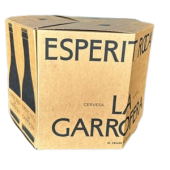

Today we want to bring to light a post by La Gaceta of Argentina in which in a melancholy way it ironizes on the uses of cardboard in the province of Tucumán. While in Europe we regulate the way in which we are going to recycle cardboard, in other poorer countries, the collection of cardboard for recycling, it supports many families.
The text, as its author points out, is a reference to an article published in the Spanish newspaper El País
In the post, Guillermo Monti gives context and tells us with mastery, an unprecedented situation lived by an Argentine family; a funeral company sent a cardboard coffin in terrible conditions as a donation to bury a deceased relative because of the Covid-19.
The Ministry of Social Development of Argentina has decided to report the funeral company to the Criminal Court and requests its immediate cessation of activities.
In Chile, the authorities banned cardboard coffins because they violated local regulations. A manufacturer from Argentina complains that governments fear the reaction of society and resist solving the problem in an economic and sustainable way.
Cardboard coffins are up to three times cheaper than wooden coffins, they are produced in series and do not pollute, but clash with the impositions of the rite of death. Controversy is open.
Text by Guillermo Monti
There's a cardboard Tucumán, like there's a cardboard Argentina. For those who live and sleep on the street, cardboard is a coat. In the settlements, the houses are collages of sheet metal and cardboard, awaiting the miracle of brick. It was settled the day to day of cardboard bores. The cardboard provides work and is part of the virtuous cycle of production.
The cardboard boxes were patented by Robert Gair at the end of the 19th century, but it is known that the Chinese used them long before. Logical, cardboard is cheaper and lighter than wood. “The corrugated cardboard is one of the most used packaging in the world to group, store, transport, display and sell consumer products.” Human beings, so far, are not included in the list of “consumer products”. But we are in Tucumán.
- October 20, 2014. Title: “In Tucumán they cast an old woman with cardboard boxes.” Summary: It happened in the Hospital Health Center and is due to the lack of inputs.
- September 23, 2019. Title: “The Telekino winning cardboard was sold again in Tucumán.” Summary: The prize consists of 9 million pesos, a van, a trip to Punta Cana and a cruise through the Caribbean.
- 5 December 2019. Title: “Horror in Tucumán: They found a dead baby in a cardboard box.” Summary: It would have between 28 and 30 weeks of gestation. They found him on the banks of the Tipas River.
- June 10, 2020. Title: “A truck that left Tucumán had $12 million in cardboard boxes.” Summary: Gendarmerie intercepted him in Santiago del Estero.
- July 16, 2020. Title: “They tried to steal a trade by covering up with a cardboard box.” Summary: The thieves failed to bring down the lattice in Mendoza at 300.
- December 12, 2019. Title: “Incidents during the Cartoneros protest in the Municipality.” Summary: they demanded from the mayor Alfaro the ill-treatment they suffer in the street.
We are made of cardboard
There is no precise record of how many people in Tucumán depend, directly or indirectly, on cardboard as an essential part of their lives. Those who collect, recycle and sell it are part of the urban landscape: a huge workforce condemned to informal employment and dependent on cardboard to put food on the table. For cardboard collectors—as for all workers in the informal economy—quarantine placed them in an agonizing limbo. The easing of restrictions rescued them, and there they are, visible to everyone yet simultaneously rendered invisible by eyes that refuse to acknowledge them. The street is where they have to be, leaving them at the mercy of coronavirus. The article cited describes one of the many realities cardboard collectors endure: mistreatment by the authorities, in this case municipal officers.
All these adjectives were used in connection with Cristian Herrera’s case: outrageous, scandalous, unheard-of, extraordinary, atrocious, incredible, inconceivable, humiliating. There were more. The coffin-shaped cardboard box intended to shelter that young life extinguished in La Costanera went around the country and beyond its borders. What abounds in these situations is the speed of finding adjectives, directly proportional to the slowness of providing answers. It is easier to be horrified by a cardboard box than by the social reality of La Costanera. As if cardboard were the cause, rather than the effect, of suffering.

“It’s cardboard,” is often pointed to the impromptu, the ephemeral, the misleading. All the nobility that the material can provide loses in comparison with the solid, with the lasting. A person is said to be “cartonated” when he fakes positions—physical and intellectual—far from his true nature. A cantoned politician calls for a expiration certificate because what is required is just the opposite: spontaneity, closeness, freshness.
The cardboard sounds ordinary and expendable, as if it were a symbol of the precarious. “Modern buildings are cardboard machines: mechanical, rigged, artificial, soulless,” said the celebrated architect Frank Lloyd Wright. Even poetry punished him: “They appear, when they turn in dark refrigerating, rigid paladins with cardboard bars,” Rimbaud wrote. A horse with a cardboard fence - the good harnesses are made of iron - represents a caricature of itself.
Watch out for cardboard masks, you can add them. With the overactions, with the exploitation of the topic (because everything adds up in the political arena of the miserable, which does not make the political arena miserable). Masks that last little (because they are cardboard, right?), usually until something new places things in the background.
Source: https://www.lagaceta.com.ar/nota/854918/opinion/somos-carton.html